

A Course in Miracles
NEW EDITION
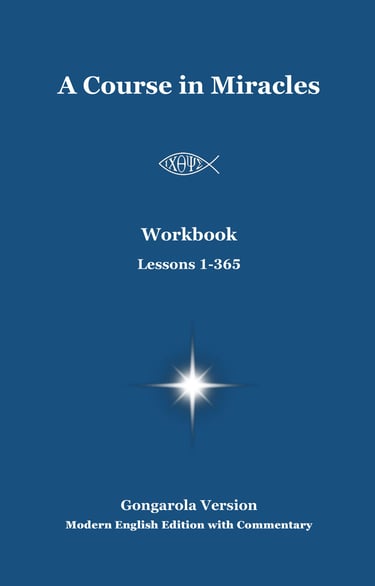
A Course in Miracles
Gongarola Version
Modern English Edition with Commentary
VOLUME I: Text I - Chapters 1-10
VOLUME II: Text II - Chapters 11-20
VOLUME III: Text III - Chapters 21-31
VOLUME IV: Workbook I - Lessons 1-150
VOLUME V: Workbook II - Lessons 151-365
VOLUME VI: Manual for Teachers and Annexes
THE WORK
This edition is a modern English version of the full dictation given by Jesus to Helen Schucman, as it appears in the Urtext and Helen’s Notes. It incorporates over 50,000 words omitted in previous editions.
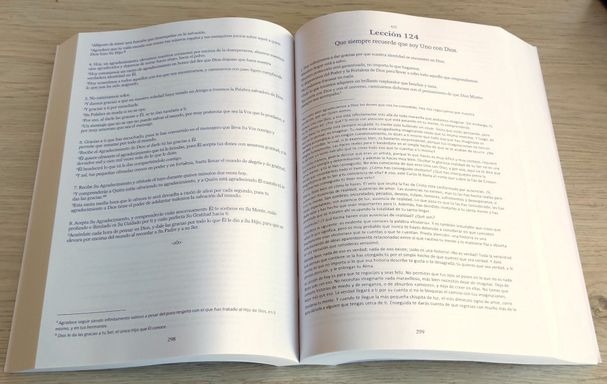
In November 2025 was published the Workbook in two volumes and one Kindle ebook. The rest of the volumes will be published in 2026.
It is different from other editions as it uses a more contemporary language and style, updated orthography according to current standards, and corrections of transcription errors from the original source, as well as conceptual clarifications and pronoun disambiguations.
From a purely formal standpoint, this work presents each sentence on its own line to enhance clarity and aid in understanding the concepts being conveyed.
Helen often warned Bill, as she dictated her notes, about certain concepts she heard from Jesus with greater emphasis, which Bill would then transcribe in capital letters. Every effort has been made to preserve these elements in order to respect their intended emphasis.
The numerous personal comments related to the scribes, which appear at the beginning of the dictation and clearly are not part of the Course, are presented in a different typeface.
The source text used for this translation is the excellent work by Dough Thompson: A Course in Miracles, The Urtext Manuscripts, The Complete Seven Volume Combined Edition.
THE NOTES
The notes in this edition of the Course serve a highly pedagogical function; one could say they are a course about the Course itself. Their sole purpose is to provide students and teachers of God with a useful teaching resource that enhances learning and saves time in the process.
The vast majority of the notes are my own, though some are drawn from Dough Thompson’s work and others from Robert Perry’s notable edition, A Course in Miracles: Complete & Annotated Edition.
This edition includes four main types of notes:
Biblical References
Thousands of cross-references with the Old and New Testaments, mostly taken from the works mentioned above.
Internal References
Notes that point to concepts found in other parts of the dictation, such as the Text, the Manual for Teachers, and the Supplements.
External References
Comments on concepts from other literary works or historical and cultural events.
Explanatory and Pedagogical Notes
This is the main, most extensive, and original body of the work—likely the most valuable for Course students. These notes stem from two decades of deep reflection on the text, as well as exhaustive research from various sources.
In the case of the Workbook for Students, the notes are not the result of exegetical analysis of the original text, but rather inspired insights offering complementary explanations. These help students better understand the Lessons and practice them more deeply.
Brief History of the Various Editions
Helen received the dictation of the main body of the Course between 1965 and 1972. However, until 1978 she continued to receive related content and personal messages. This work presents all known material to date in its original form.
Helen transcribed what she heard from Jesus in shorthand notebooks, known as Helen’s Notes. The following day, she would dictate what she had received to Bill, who typed it into what became known as Bill’s Transcripts—of which no copy remains. These typed pages were the basis for what is now known as the Urtext.
It is important to note that Helen did not dictate everything in her notebooks to Bill; at times, she would also share material she had just received. Therefore, in the early chapters of the dictation (up to Chapter 8), neither the Notes nor the Urtext contain the full material.
In 1972, Helen and Bill edited the Urtext, removing nearly all personal and technical content, rewriting many original expressions, and structuring the work into chapters and sections for the first time. This version, intended for Hugh Lynn Cayce—son of the well-known psychic Edgar Cayce, whom Jesus refers to several times early in the dictation—is known by the acronym HLC.
In 1973, Helen Schucman and Ken Wapnick collaborated on the preparation of the final edition of the Course, published in 1975. This version became the global reference thanks to the tireless dissemination efforts of the Foundation for Inner Peace (FIP). We gratefully acknowledge the FIP as the original publisher authorized by the scribe and honor its historic custodial role in overseeing the official translations that have carried the message to every corner of the globe.
From an editorial standpoint, the 1975 edition aimed to consolidate the final structure of the work. This process entailed the exclusion of approximately 50,000 words present in the Urtext and the relocation of about 6,000 words from their original context, primarily affecting the first eight chapters.
In retrospect, these editorial decisions can be seen as understandable and perhaps even necessary within their historical context. It is likely that the removal of material sought to avoid unnecessary controversy in the early stages, making the Course less contentious and its essential points more accessible to the reader encountering the work for the first time.
In 2004, the original dictation of the work entered the public domain in the United States. This legal circumstance is what allows us today to offer this new restored edition, designed for the student who, while valuing the accessibility of the standard version, now wishes to take the next step and delve into the entirety of the original dictation without omissions.
Copyright
All rights to the translation and notes are reserved.
However, I authorize the good-faith use of significant excerpts from this work for reference in other editorial productions or for free dissemination with educational purposes. In such cases, I would appreciate the courtesy of citing the source.
I also expressly authorize and encourage the daily distribution of the Workbook Lessons by email to Course study groups. This is a practice I have implemented with my own students and have found to be highly effective.
The only restriction is that it is not permitted to copy, market, or disseminate the entire work or its various parts in a single document in any format or medium.